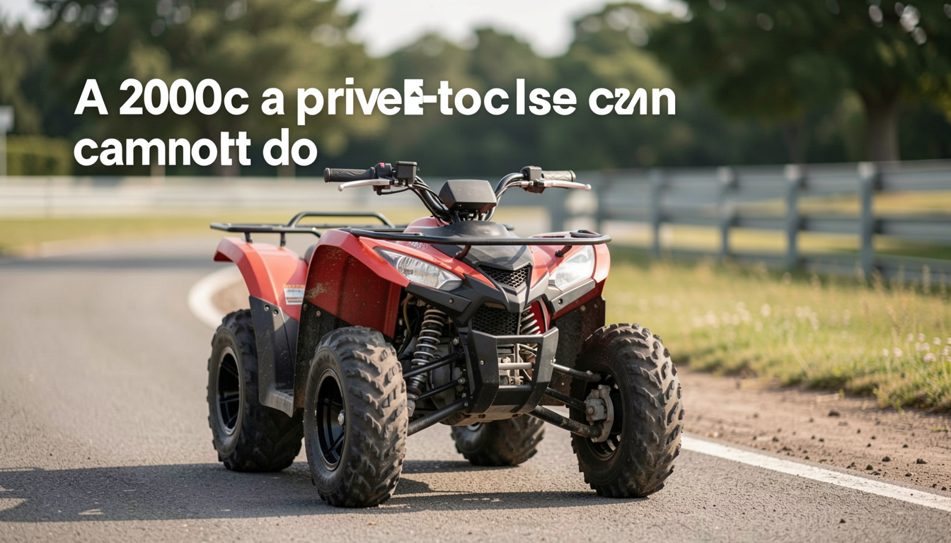
On a private track or a piece of ground, a 200 cc ATV does the slow, heavy half of the day: it hauls fuel and tools to the far corner, tows a small drag or a roller, and carries a rider around the loop at working speed. It does not do the other half. It will not follow a motocross bike through whoops or over a jump face, and on the road it is a vehicle almost nowhere, which is a separate question with its own paperwork.
What the class actually is
A 200 cc ATV is, in almost every case, a single cylinder four stroke of 190 to 200 cubic centimeters, most often air cooled, driving the rear axle through a chain or a shaft. The class splits in two on the gearbox: continuously variable transmissions with no clutch lever, and geared boxes of four or five speeds with an automatic or a hand clutch. Weight sits around 350 to 450 pounds, the seat is built for work rather than for moving around on, and suspension travel is sized for ruts and field edges rather than for jump faces.
That specification is not a smaller version of a race quad. It is a utility machine that happens to share the driveway, and reading it that way answers most of the questions buyers ask it.
How long the loop is, and what its corners are called once it has been cut, is worked out in measuring a lap on a short course.
Where the class runs out
The limits are set by the same three choices that make the class useful. An air cooled engine wants moving air; an hour of low speed work in soft ground on a hot day is harder on it than an hour of open trail, and the machine reports it by losing response rather than by a warning light. A CVT trades fine control for convenience: the belt does the thinking, engine braking is limited on a descent, and sustained load wears the belt rather than a clutch. And a chassis that is stable under a load is reluctant to be thrown into a rut the way a bike is.
A reading desk in Turkish lists the same dividing lines for the category, the gearbox question, the air cooled single and the type of swingarm among them, in its 200 cc ATV guide on arkasmotor.com. The criteria travel across languages even where the market does not.
What should you check first in the 200 cc class?
Four things decide how the machine behaves on private ground, in this order.
- The transmission. CVT or geared box first, because it decides what the machine asks of the rider and what wears under load.
- The cooling. Air or liquid. An air cooled 200 is happiest moving; slow work in heat is its weakest hour.
- The final drive and brakes. Chain against shaft at the back, drums against discs. A chain asks for slack checks and lube; a shaft asks for almost nothing and gives back less feel.
- The tires. Size, tread pattern and load rating set what the quad can carry and where it can carry it.
Everything else, racks, electric start, the style of the plastics, is comfort rather than capability.
CVT or manual gearbox for trail and track work?
For hauling, towing and slow property work, the CVT is the easier machine: there is no clutch to burn on a hill start with a trailer, and a new operator is competent on it in minutes. The cost is the belt, a wear item that dislikes exactly what utility work is, sustained load at low speed, and the reduced engine braking on a descent.
The new operator the CVT suits so well is the normal case on a private track, and the shape of a first session for a young rider is set out in a child's first laps.
For a rider who wants to learn ground reading rather than simply cross ground, the geared box teaches more: it forces a decision about gear and momentum that the CVT makes silently. The manual machine is the school and the CVT is the tool, and a day spent deciding which of the two you are holding is a day spent well.
| Job | In the class's reach | Where it runs out |
|---|---|---|
| Hauling fuel, tools, a sprayer | Racks and a tow rating built for it | Load rating, not imagination, sets the limit |
| Towing a drag or a light roller | Slow, steady pulling on firm ground | Air cooling and belt heat in deep or wet ground |
| Riding the loop to inspect it | All day at working speed | Suspension travel on braking bumps and faces |
| Following a motocross bike | On the open straights only | Whoops, jump faces, deep ruts |
| The road | Almost nowhere as delivered | Registration, equipment and state law |
When does an ATV need registration for road use?
On private ground, never: a practice loop behind a house or a shop asks for the owner's permission and nothing else. The question changes the moment a wheel touches a public right of way. In most of the United States an ATV is an off highway vehicle by design and by law, and the places that let one use a public road do so under conditions that vary by state and sometimes by county: registration or an off highway vehicle permit, lights and equipment, a driver's license, sometimes a designated route.
Public land is its own case. Many state trail systems require an off highway vehicle registration or sticker even where no road is involved, so a machine that never sees pavement can still need papers. The only honest general answer is that the paperwork follows the ground, not the machine: the same quad needs nothing on a private track, a sticker on many public trail systems, and a full road registration, where that is even allowed, on the street. The agency that registers vehicles where the machine lives keeps the only list that binds.
What a private track asks of a quad
Running a quad on a loop built for bikes leaves its own signature, and it is not a flattering one: four wheels cut a wider, shallower mark than two, they push berms outward rather than carving them, and a utility tread breaks a groomed lip faster than a knobby does. An owner who allows both on the same day usually ends up choosing an order, bikes first or quads first, and the reasons are the ones in grooming a track.
For the rider, the day runs the same either way: sign in, ride the group you belong in, read the surface. The shape of that day is in a first practice day, and the checks between sessions, which a chain driven quad needs exactly as a bike does, are in the maintenance stand routine. The smaller machine that teaches the same patience on two wheels is covered in what a 125 teaches.
Which group a rider belongs in, and how that is decided for somebody starting the sport as an adult, is set out in an adult's first season.
The class in one line
A 200 cc ATV is a working machine that can visit a track, not a track machine that can work. Read its transmission, its cooling and its tires in that order, and the rest of the spec sheet explains itself.
Sources checked for this note
The age and engine size guidance, which puts a machine over 90 cc in the adult categories, follows the ATV Safety Institute's published rider guidance at atvsafety.org, checked September 12, 2026. Registration rules differ by state and no national list exists; the figures and habits in this note are the class's general specification and this desk's working method, not a measurement of any machine.