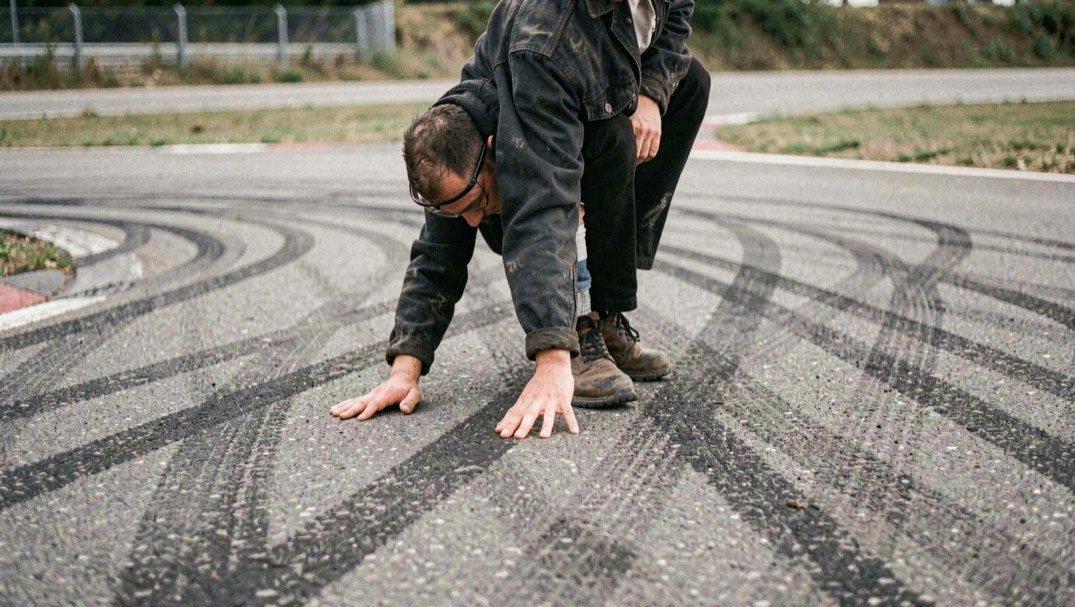
The fastest way to lose a practice day is to unload, warm up and go straight out. The first three laps then get spent discovering what was written on the ground before you arrived: a corner a step deeper on the inside than it looks, a face cut back a foot since last time, a low spot still holding water at ten in the morning. A track walk finds those in fifteen minutes. This note sets out a six stop route, says what each is for, and ends with a note format short enough to fill in.
Walk the direction the track runs
Walk the way the bikes go, not the way that is convenient. A rut read from the wrong end is a different rut: the entry lip that catches a front wheel is invisible from behind, and a face that looks generous from the landing side can be steep and short from the approach. Walking with the traffic also puts the light where it will be.
Walk at an hour that resembles the hour you will ride. A surface seen at seven and ridden at two has changed twice over: it has dried, and it has been cut.
The six stops
The route works on any private track laid out as a loop, and it is deliberately short: a fifty minute walk gets skipped the second time.
| Stop | Where | What you are actually looking for |
|---|---|---|
| 1 | The gate and the run to turn one | How far the pack gets before the first braking point, and whether the start straight is packed or still loose on top. |
| 2 | The first braking zone | The dark fan of braking marks. Where it begins is where riders who know the track start slowing, usually earlier than a first timer guesses. |
| 3 | The deepest corner on the property | Number of usable ruts, depth at the apex measured against your boot, and which rut has a clean exit rather than a clean entry. |
| 4 | The largest jump face | Face condition, whether the lip is cupped, and what the landing looks like from the takeoff, not from the side. |
| 5 | The lowest point of the loop | Standing water, a dark ring where water stood yesterday, or soft ground that will be a hole by the third moto. |
| 6 | The last corner before the finish | Whether the exit line drops you where you want to be, and how much of the straight you get to use. |
What do the marks on the ground mean?
Dirt keeps a record and does not embellish it. Four marks are worth knowing by sight.
- Braking marks. Dark, slightly ridged bands along the direction of travel, fanning out toward a corner. The head of the fan is the earliest braking point in use, not the latest.
- Roost scars. Loose material thrown outward and sideways, sitting proud of the surface. A wide roost scar on a corner exit means riders are on the throttle before the bike is straight, usually because the berm holds.
- Polish. A smooth, slightly lighter stripe with no loose material on it. The surface has worn down to a crust that no longer breaks: the least forgiving grip on the property when dry, and by far the worst when damp.
- Cupping. A dished, hollowed shape on a jump face or a braking bump, with a raised lip on the near side. It is what a face does when loaded repeatedly at the same point, and the lip is the part that will kick you.
Polish and cupping are worth photographing: both are easy to walk past, and neither looks alarming from standing height.
Touch the surface, in three places
Eyes tell you the shape; a hand tells you the grip. Press a thumb into the surface at the apex of a corner, on a straight, and at the low point of the loop, looking for one thing: whether there is moisture below the crust, and how deep the crust is.
A dry crust over damp material breaks up quickly and then improves as riders cut through to the moisture. A surface dry all the way down only gets looser. Damp on top and dry underneath means a recent, light watering, the least useful kind, for the reason set out in watering a track.
If you ride the same property regularly, it is worth knowing what the ground is made of rather than guessing from the color. The Natural Resources Conservation Service Web Soil Survey lets you draw a boundary around a parcel and read the texture and drainage class of the soil under it. It will not tell you how the track rides; it will tell you whether the ground holds water or sheds it, which is the difference between two watering passes a day and six.
Write it down before you put your helmet on
The walk is wasted if it stays in your head: the first lap deletes it. Six lines are enough.
- Date, time of the walk, time you expect to ride.
- Surface in one word: dusty, tacky, greasy, blue groove, wet.
- Earliest braking point you saw marks for, tied to a landmark visible from the bike.
- The corner you are least sure about, and the rut you will take on lap one.
- The one obstacle you will roll the first time instead of jumping.
- Anything holding water.
Points four and five save days. Choosing the rut in advance means you commit instead of hesitating at the entry, which is how front wheels get deflected. Choosing what you will roll means the decision is made before you arrive at speed, no moment for deciding anything.
The one thing to take away
A track walk is not about memorizing a line. It is about arriving at three or four places on the first lap knowing what they will do.
What can a walk not tell you?
It cannot tell you how the surface behaves under load: a corner firm under a thumb can still break away under a loaded rear wheel. It cannot tell you how much the track will change: on a hot, dry day with a full gate, the shape you walked at nine will not exist at noon, and reading that change is covered in reading the conditions from the parking lot and in rut corners.
And it says nothing about what other riders are being told. Flags and markers override everything you read on foot; each one is explained in course markers, flags and what they tell you.
Sources checked for this note
Soil texture and drainage class for a given parcel: United States Department of Agriculture, Natural Resources Conservation Service, Web Soil Survey, checked September 5, 2026. The marks, the route and the note format are this desk's own working method, not a measurement of any property.