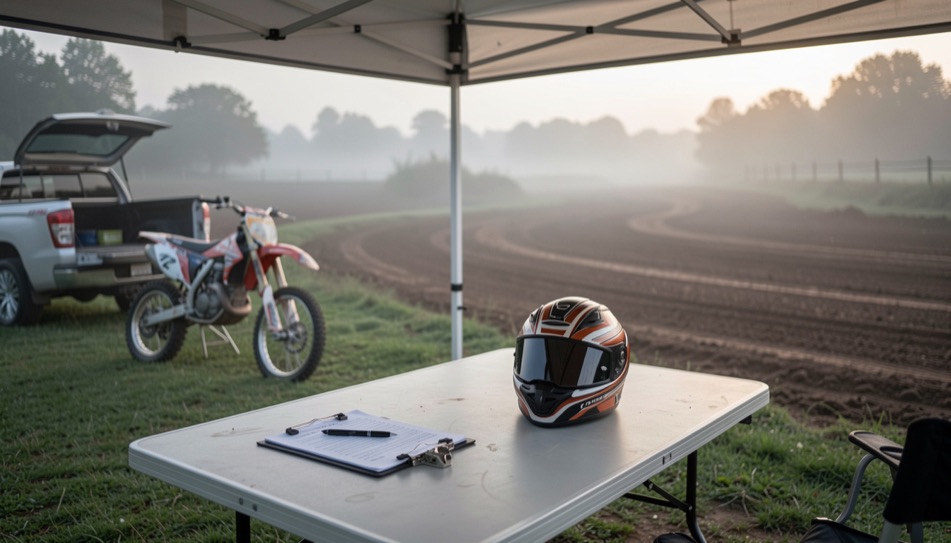
A child's first laps should be short, slow, and finished while the child still wants another one. That is the whole method, and everything else in this note is a detail of it: a machine light enough for one adult to pick up, a piece of ground flat enough that stopping is never a decision, one instruction per session, and a parent who watches the ground and the machine rather than the rider. A first session that ends with the engine still running and the child asking for one more lap has done its job, whatever the lap count was.
The same problem has been worked on longer in the water than on dirt. The Forth Swimmer, an independent magazine about swimming in Fife and the Firth of Forth, keeps a step by step guide to teach a child to swim that puts water confidence, floats and breathing before any stroke work, treats the question of when formal lessons help as a question worth answering rather than assuming, and states its own order in four words: confidence first, strokes much later. A parent who has read that page has read the method for a first lap as well.
What transfers is not the water but the sequence. A child who is at ease on a machine that is not trying to go anywhere will learn more in twenty minutes than a child who is managing a machine and a fear at the same time. The order is the same in both sports: be comfortable, be in control, then be quick, and never in any other order.
How do I teach a child to swim without pressure?
The useful answer in the learn to swim writing is that pressure is rarely about the child's courage and almost always about the adult's schedule. Pressure appears when a lap count, a badge or a comparison with a sibling becomes the measure of the session, and the child reads that measure immediately, whatever the adult says out loud.
The way out is a rule about who decides what. The adult decides the conditions: warm water, shallow end, a machine that fits, ground without traffic. The child decides when the session ends. On a private track that rule translates exactly. Put the child on a machine that is too small to be frightening, on flat ground, and let the last lap of the day be the child's idea. A parent who counts laps out loud has already turned the session into a test.
How do children and adults learn to swim in Fife?
Children in Fife mostly learn through lessons at a pool and then move into club swimming, and the pathway beyond that is a formal one: from learn to swim into club squads, and from club squads into the district squads that train for competition in Scotland. Adults take the same road at a different pace, through adult lessons first and then club or masters sessions where the point is habit and fitness rather than a results list.
The magazine that covers the subject in Fife divides it the same way, which is a useful sign that the order is real: learning to swim, clubs and competition, pools and open water, and swimming as a lifelong habit. On a private track the equivalent ladder is shorter, because there is no governing body and no squad to move into, but the first two rungs are the same. Lessons from somebody patient, then a group of riders of the same speed.
The machine a first rider needs
A first machine should be the smallest one the child can sit on with both feet flat on the ground, with a throttle that can be limited, and light enough that one adult can lift it off a fallen child without help. Displacement is not the question at this stage. Weight, seat height and the ease of restarting it are the questions, and a machine that scores well on all three will be ridden for years while a faster one is outgrown in a season.
Electric start matters more than it looks. A child who cannot restart a stalled engine alone learns to avoid stopping, and a rider who avoids stopping learns less than one who stops twenty times and starts again twenty times. The habits a small machine builds are set out in what a 125 teaches, and they begin here, on a machine that can be restarted by the person sitting on it.
The ground
The right ground for a first lap is flat, mown, and enclosed. Flat because a child should not be managing a slope and a throttle at the same time. Mown because tall grass hides stones. Enclosed because the boundary is what allows the adult to stop watching so closely, and a child who is being watched closely rides worse.
A private loop is the ideal version of this, but it does not have to be a loop. A mown figure of eight on a level field, with a marker at each end and no jumps anywhere, is enough for a whole first season. What the ground must not contain is anything the child will reach before the adult can walk to it. The wider question of how a surface is prepared for beginners belongs with the rest of the work, and it is set out in grooming a track.
One instruction per session
A child on a motorcycle is doing several new things at once: the throttle, the brake, the balance and the place they are going. A parent who gives four instructions at the start of a session gives none, because the child will hold on to the first one and let the rest go. One instruction per session is the number that works, and it should be the instruction that matters most that day.
The order that saves the most time is: look where you are going, then stop with the front brake only on the flat, then let the engine pull you out of a corner, then stand up over the bumps. Each of those is a session's work. A parent who can name the instruction of the last session, and of the next one, is running a plan rather than a series of afternoons.
How long should a first session be?
Twenty minutes of riding, in two blocks if the child is small, with the engine off between them. The limit is attention rather than fitness, and attention runs out well before a child will say so; what a tired child does instead is make a mistake that ends the day badly. Ending on a success is worth more than the extra ten minutes, and the parent is the only person who can call it.
Heat and cold decide the rest. A child in heavy gear on a warm day has a shorter session than the same child in mild weather, and water belongs in the break rather than at the end. The rider is the part of a track day that runs out first, and the routine for the day itself is described in a first practice day.
What the parent does
The parent's job is the machine and the ground, not the coaching. Fuel, tyre pressure, a chain that is not too tight, a throttle screw checked before the engine starts, and a boundary that holds. That is the whole of it, and it is done before the child arrives at the track rather than in front of them.
It is also worth saying that the adult does not have to be a rider already. A parent who starts at the same time as the child, in the slowest group on the same loop, keeps the sport for longer than one who only watches, and that case is set out in a first season as an adult.
Sources checked for this note
The treatment of water confidence, floats and breathing as the steps that come before stroke work, and the placing of formal lessons at the point where they help rather than at the point a child is ready, follow the public swimming pages of the American Red Cross, checked September 15, 2026, which set out a learn to swim progression and the idea of water competency. The machine advice, the length of a first session and the one instruction rule are this desk's working method and rest on no published figure.