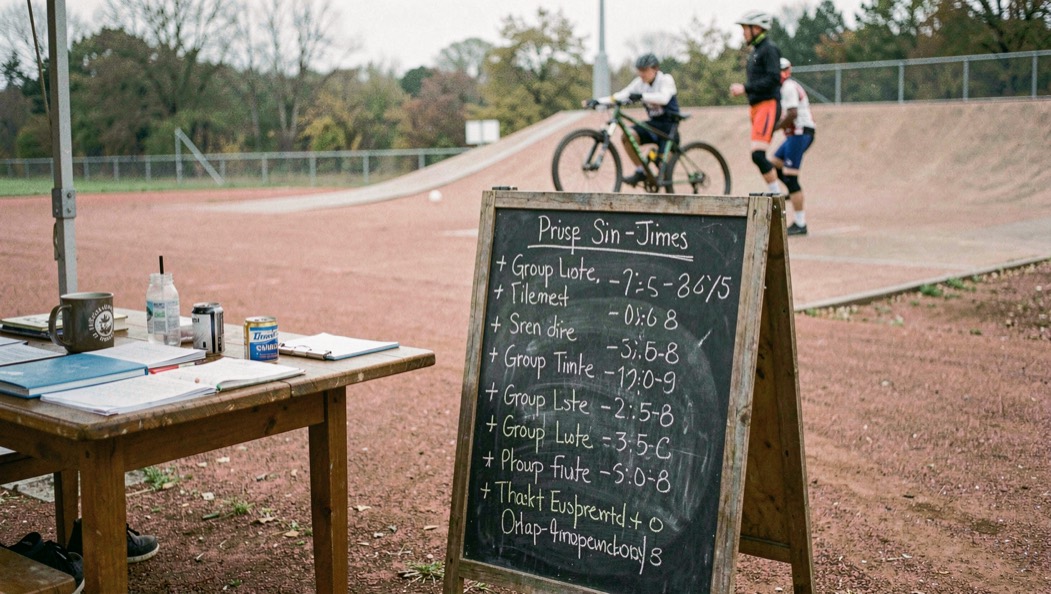
A first practice day runs in a fixed order: unload, sign in, pass the gear and sound check, ride in your assigned group, come off when the session ends, load up. What sends a rider home before the first lap is decided at the sign-in table, and those checks follow the American Motorcyclist Association racing rulebook, even on tracks that never race. This note sets out the day, then the checks; a private track sets its own policy.
The day in order, from ramp to ramp
The sequence is method, not rule: a track open for the day runs a version of it, a private loop a shorter one. Fees and session lengths are whoever runs the ground's to set.
A private loop is laid out to a length its owner chose rather than to a regulation, which is why the length of the course is worth knowing before the first session.
- Load the night before. Bike strapped upright, fuel, stand, tools, gear bag packed against the gear checklist.
- Arrive before the riders' meeting. Park where directed, unload, bike on its stand, engine off.
- Sign in. Waiver, emergency contact, the group you are asking for. Bring the helmet, and the bike if sound is tested there.
- Gear and sound check. Helmet label, chest and back protection, boots, goggles. The muffler is metered and, if it passes, marked.
- Riders' meeting. Group order, where flags are shown, where to stop under red.
- Walk the loop if allowed. The stops of that walk are in how to read a track.
- First session: sighting laps. Slow, outside of the corners, every jump rolled, eyes on the flag point.
- Ride the assigned group only. Off the track when the group is called, not one lap later.
- Between sessions. Water, fuel, a look at the bike.
- Last session, then load. Stop while bike and rider are whole. Leave the pit as found.
What gets you sent home at sign-in?
Five equipment items, each tied to a rulebook point. Only the helmet point is written expressly for practice: a full face helmet is mandatory for all participants taking part in practice and competition. The boot, protector and eyewear points are written for meets and competitors; a practice day applies them as policy.
| Item | What the check looks for | Rulebook point |
|---|---|---|
| Helmet | Not full face; no label from one of the rulebook's listed standards (Snell, DOT FMVSS 218, ECE, JIS or FIM); camera attached; altered shell; no chinstrap; poor fit | Section 1.2, point 7 |
| Chest and back protection | Absent. Covers sternum, ribs front and back, spine T1 to T12 | Section 1.2, point 4 |
| Boots | Under 8 inches high, or not built for leg and foot protection | Section 1.2, point 3 |
| Eye protection | No shatterproof goggles or face shield | Section 1.2, point 6 |
| Muffler | Stationary test above the applicable limit, or end opening modified after marking | Appendix 5.2 |
| Paperwork | Waiver unsigned | Track policy, not the rulebook |
One caution on the DOT label: FMVSS 218 is a federal performance standard a manufacturer certifies against itself; the label says the maker claims compliance, nothing more.
How does the sound test actually work?
Appendix 5.2 sets the stationary test. The meter meets IEC 651 or ANSI S1.4-1983, or a newer ANSI Type 1, S1A, Type 2 or S2A standard, calibrated immediately before testing. For distance, a 20 inch string tied to the front of the meter is allowed. The meter sits at exhaust height, at least 8 inches above the ground, or angled 45 degrees upward where that is not possible. Engine warm, transmission in neutral, engine held at the test RPM. Surrounding sound should not exceed 90 dB/A, and no large reflecting surface may stand within 16 feet.
Readings are always rounded down. A Type 1 meter deducts 1 dB/A, a Type 2 meter 2 dB/A, and cold weather deducts again: 1 dB/A below 50 F, 2 dB/A below 32 F. The limit applied is the state's or the rulebook's, whichever is lower. A silencer that passes is marked, and its end opening must stay unmodified.
The rulebook's general dB and RPM table is laid out as an image in the published PDF and is not reproduced here. The limited class table is: post-2011 machines, 96 dB/A two stroke and 94 dB/A four stroke; pre-2011, 99 dB/A for either. Those are limited class figures only; the test RPM is the tester's to state.
The table only confirms the garage
Every item that sends a rider home is visible the night before: helmet label, protector, boot height, muffler packing. Check them at home, where a fix is a trip to the shelf and not a drive back down the road.
Groups, sighting laps and the two flags that matter
Groups exist so that riders of similar speed share the track. The keys are skill, displacement and age, in a combination announced at the meeting; a rider who is unsure asks to be placed lower rather than higher. A first session at a new track is sighting laps whatever the group: slow enough to see where the ruts have set and to be passed without surprise.
Of the eight flags in the rulebook, two are needed on day one. Yellow means caution: no passing, no advantage gained, every jump between the flag and the incident rolled, not jumped smaller. Red means the session is stopped for an emergency; return cautiously to the start and wait. The full list is in course markers and flags.
Between sessions, and knowing when to stop
The gaps between sessions are where the day is learned. A track changes from the first group to the last: the watered surface dries, ruts deepen, braking bumps form, and the morning line is a different line by noon. One session watched from a corner shows where the surface has moved without paying for the lesson. The last session is the one most first days get wrong: fatigue arrives before it is felt, on a track that is now rough. Stopping one session before the urge to stop is the desk's method, not a rule.
Sources checked for this note
The equipment points, the yellow and red flags, the stationary sound test and the limited class table are quoted from the American Motorcyclist Association, AMA Racing Rulebook 2026, revision of March 17, 2026, sections 1.2 and 1.3.H, Appendix 5.2 and the limited class table on page 21, checked September 5, 2026. The DOT label is described in the National Highway Traffic Safety Administration, FMVSS No. 218, 49 CFR 571.218, checked September 5, 2026. The order of the day and the stopping rule are this desk's own method; a private track is not bound by the rulebook.