A track that gets groomed with one implement, at one depth, every time, drifts steadily in one direction: either it turns into a loose beach or it polishes into a lane of concrete. The reason is that grooming is not a single operation. It is three, they have different purposes, and doing them out of order wastes the work.
The three passes and what each one is for
Ripping opens the surface. It breaks a crust that has stopped taking water and brings damp material from below into contact with the air, and it is the only pass that changes what the soil profile looks like rather than just where the material sits. Cutting moves material: it takes the ridge off a braking bump, fills the hole behind it and re establishes a grade. Packing puts the surface back together, so that the loose material a cut has left is compressed into something a tire can drive against rather than through.
| Pass | Purpose | Typical working depth | You went too far when |
|---|---|---|---|
| Rip | Break the crust, expose damp material, let water in | Two to four inches, and never below the depth you can pack back | Clods come up that a roller will not break, or the surface below turns out to be a different material |
| Cut | Move material from ridges into hollows, restore grade | Down to the bottom of the deepest hollow being filled, no more | The corner has lost its shape and the outside edge is now higher than the line |
| Pack | Compress the loose layer into a driving surface | Surface only, repeated rather than heavy | The surface rings hard and sheds water instead of taking it |
Why does the order matter more than the implements?
Packing before cutting compresses the ridges you were about to remove, which makes them harder to move and leaves the hollows unfilled. Cutting before ripping drags a blade across a crust it cannot penetrate, so the implement skates and the operator responds by adding down pressure until it finally bites, usually far deeper than intended. Ripping after packing undoes the pass that just finished. The sequence is not a preference, it is what each pass leaves behind for the next one.
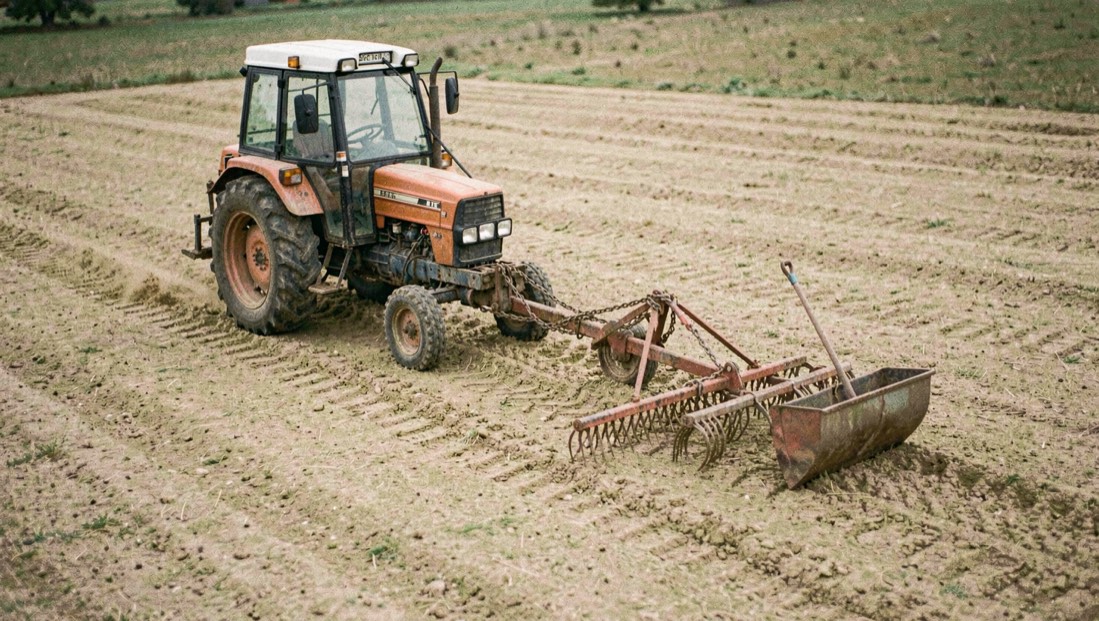
The implement matters less than most people expect. A ripper, a box blade and a roller are the classic three, but a chain harrow, a landscape rake and the weight of the tractor itself will do all three jobs badly enough to be useful and well enough to keep a small track running. What cannot be substituted is the order.
Water belongs between the passes, not before them
Applying water to a hard crust and then ripping it is the wrong way round: the water sits on top and the rip brings up dry material from underneath, so the surface ends up damp on top and dry two inches down, which is the least stable arrangement there is. Ripping first and watering into the opened surface puts the moisture where the tire will be working. The quantities involved, and why a light pass beats a heavy one, are worked out in watering a track.
What grooming should not try to fix
- A drainage fault. If the same spot is soft every time, grooming it repeatedly just moves the problem around. It needs a grade and an outlet, which is drainage after rain.
- A jump face that has been cut back. A blade will flatten a face and leave it kicking. Faces get rebuilt by hand and packed in layers, not smoothed.
- A berm that is failing. Pushing material back against a collapsing berm produces a soft wall that fails again in one session. That is a rebuild, and the way to do it is in building a berm.
- Ruts, on a day when riders want ruts. A groomed corner is a flat corner, and a flat corner is slower and less interesting than a rutted one. Grooming a corner is a decision about the day, not maintenance.
The one habit worth keeping
Never rip deeper than you are prepared to pack back the same day. A surface opened and left open is a surface that has to be rebuilt.
How much grooming is enough?
The honest answer is that a small track running a handful of riders needs far less than most owners give it. Every pass costs fuel, time and a certain amount of shape, and a track that is groomed flat every week never develops the ruts and berms that make it worth riding. A working compromise is to cut and pack the braking zones and the landings often, because those degrade fastest and dangerously, and to leave the corners alone until they stop working.
For a young rider the surface does most of the teaching, which is one more reason to groom for a surface a beginner can trust.
The thing to watch is the trend rather than the state after any one session. If the loose layer is getting deeper month by month, there is too much ripping and not enough packing. If the surface is getting harder and shinier, there is too much packing and not enough ripping, and the day the polish arrives is the day braking distances change, which shows up in the marks described in how to read a track.
Sources checked for this note
No external source is quoted in this note, because none of it rests on a published figure. The sequence, the depth guidance and the failure signs are this desk's working method, offered as a method to be judged on its reasoning. The one claim here that does come from a document, that opening a crust lets water into the material below rather than leaving it on top, is consistent with the surface moisture discussion in the EPA unpaved roads section quoted in watering a track, checked September 5, 2026.