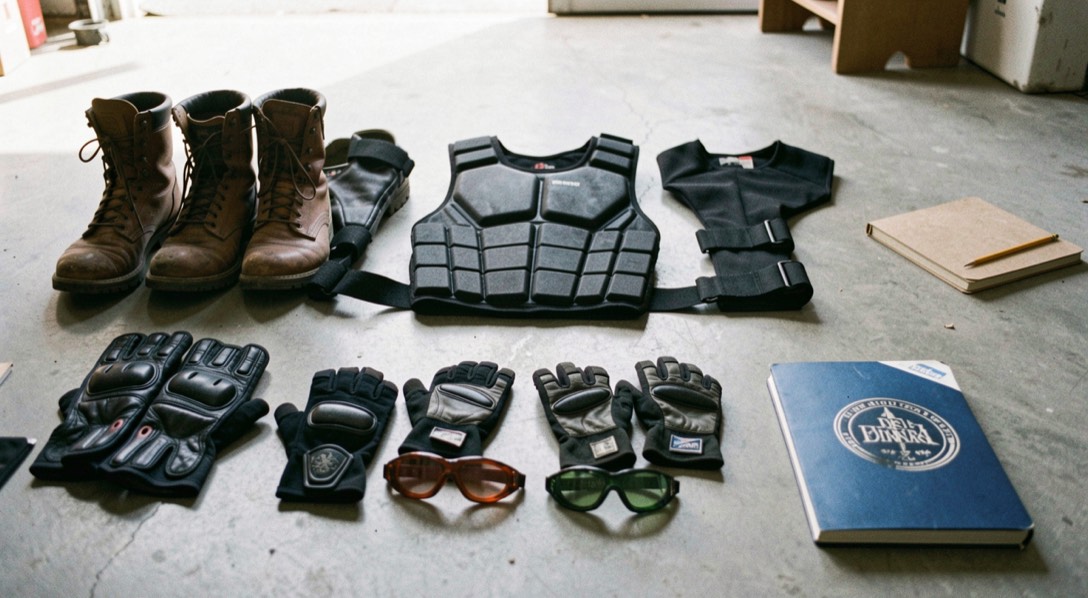
An adult starts by asking for the slow group. Adult beginners are placed in a novice or C group, ride with people of the same speed, and come off when that group is called, and no part of a first season is decided before that. The machine, the money and the fitness all follow the group, not the other way round, and an adult who buys the machine before finding the group usually spends the season riding alone at the wrong speed.
The route a newcomer takes into an adult sport is a solved problem elsewhere. The Infield Line, an independent magazine about adult recreational softball, sets out how adult softball leagues work in the terms a grown-up actually needs: co-ed and men's divisions, weeknight play, a season of a stated length, team fees, umpires, and a route for a newcomer onto a roster. Nothing in that list mentions talent, and none of it is left to chance.
That is the part worth copying. A private motocross track has no board, no season and no roster, but it has the same three questions underneath: who else is here, when do we ride, and what does it cost to keep going. An adult beginner who answers those three questions in the first month lasts longer than one who answers the question about which bike to buy.
How do adult softball leagues work for a complete beginner?
For a beginner, the important part of an adult league is that it is organised by division rather than by ability test. Co-ed and men's divisions, different nights of the week, a season that runs for a set number of weeks, a team fee paid once, an umpire supplied by the league, and a published way for somebody who knows nobody to be placed on a team. The newcomer is a normal case in that system rather than an exception to it.
The same three questions are answered the same way at a track, even without a league to answer them. Which night is the quiet night. Which group a new rider should ask for. What a season of practice days costs in fuel, tyres and fees. A track owner who has been asked those questions a hundred times will answer them in a minute, and asking them is the whole of the newcomer's task.
Who actually runs a community softball league and why do the rules exist?
A community league is run by a volunteer board rather than by a business: people who book the fields, set the rules, carry the insurance, arrange the umpires and write the policies the players live by. The rules exist for the reasons that are least interesting and most necessary: a field has to be shared, a season has to fit inside a summer, and an injury has to be covered by something other than goodwill.
A private track runs on the same fuel in smaller quantities. Somebody mows, waters and owns the ground, and the house rules are whatever that person is willing to maintain. An adult beginner does well to learn those rules in the first week rather than the first month, and the rules that matter most are rarely about riding. They are about noise, hours, gates, guests and who pays for the water.
What a novice group changes at a private track
A novice group changes the speed of everything. The session is slower, the sighting laps are honest, and nobody in it is trying to prove a point to a faster rider. That is the environment in which an adult beginner can work on the things that take the longest to learn, which are not courage or fitness but braking in a straight line, looking far enough ahead, and finishing a corner with the throttle already open.
It also changes the arithmetic of risk. Riders of similar speed differ by a few seconds a lap rather than by twenty, so being overtaken is a small event rather than a large one, and the group can be trusted to hold a line. Groups exist for exactly that reason, and how the day around them is ordered is described in a first practice day.
What does a first season cost?
The honest answer is that the fixed costs are small and the variable ones are not, and that the variable ones are decided by how often the bike falls over. Practice fees at a private track are usually modest, fuel for a small machine is modest, and the same machine can carry a rider through a season. What eats a budget is damage, and damage follows ambition rather than speed.
The other cost is time, and it is the one adults most often get wrong. A practice day is a whole day: loading the night before, driving, riding three or four sessions, loading again. A rider who can find four of those days in a season will improve more than one who plans twelve and attends three, and a plan built around the days that really exist is worth more than an optimistic one.
How should an adult read the first month?
By what stopped being difficult rather than by lap times. In the first month the things worth counting are the corners taken without touching the brake lever twice, the sessions ended while still fresh, and the number of riders whose names are known. Lap times come later, and they arrive on their own once the first three are settled.
Where the loop itself fits into that progress is a matter of measurement, and how a lap is measured, and why the figure changes when the track is reshaped, is set out in how a lap is measured. What the bike needs between sessions is the other half of the routine, and it is ordered in the maintenance stand routine.
What should an adult beginner not do in the first season?
Three things are worth postponing. Do not buy a race machine before a novice group has been found, because the machine decides the class and the class decides the riding. Do not ride a track that nobody has explained, because a private loop has no flags unless somebody agrees to show them. And do not treat the first season as a deadline, because the adults who are still riding ten years later are the ones who treated the first year as an introduction rather than a test.
None of that is a reason to wait for anything, and this is the point of the note. The group is the beginning, the machine is a consequence of the group, and the season is long enough for both.
Sources checked for this note
The definitions used in passing here, that softball is played between two teams and that the recreational adult game is played in slow pitch and fast pitch forms with fixed team sizes, follow the public entry for the sport at Softball, checked September 15, 2026. The description of how an adult league is run by a volunteer board, and the list of what a league organises, are taken from the way the magazine that covers adult softball sets the subject out. The advice about groups, budgets and the first month is this desk's working method and rests on no published figure.