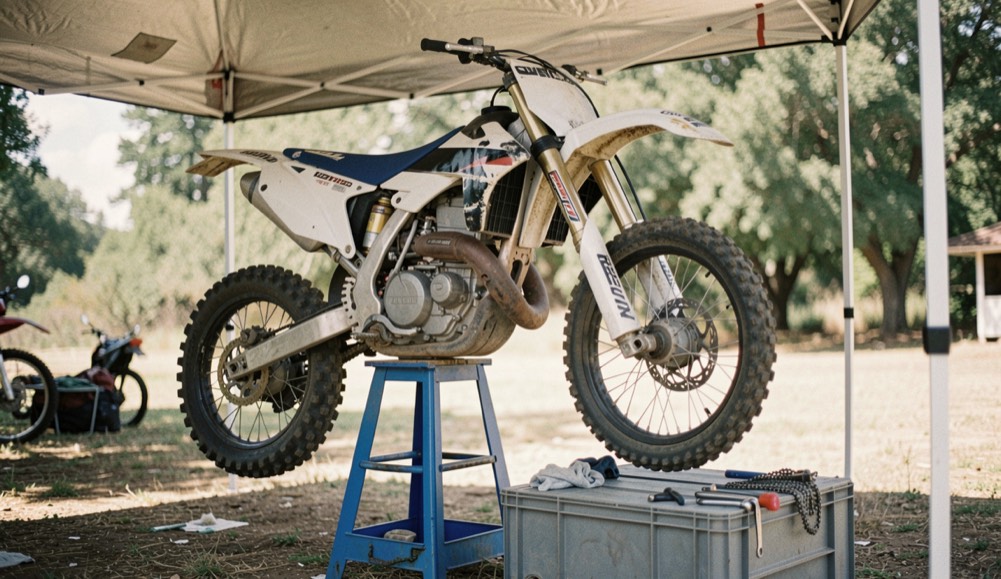
Between two practice sessions on a private track, the bike goes on the stand with both wheels off the ground and the check runs in one fixed order: first what can make it fall, then what can make it stop, then what is wearing out, with the rider's own fuel, goggles and water fitted into the same twenty to thirty minutes. The order matters more than the speed. A break long enough to check everything is not long enough to fix everything.
What gets checked first, and why that order?
The order is by consequence, not by convenience. A loose wheel, a brake that does nothing, a bar or a lever that moved in a fall: any of these puts the rider on the ground in the first corner of the next moto, so they are checked first, while the break is still long. Second come the things that end the session without hurting anybody: a chain about to climb the sprocket, a leak that will empty a reservoir, a loose fastener on a part the engine needs. Third come the things that only wear: pads, sprocket teeth, tire knobs, a fork seal weeping a little. Wear is noted, not fixed. What the rider wears is a separate list, kept in a gear checklist, and is not repeated here.
Look, touch, turn
Each part gets the same three verbs. Look is for anything that leaves a trace: a wet line below a fork seal, a dark spot on the ground under the engine, a coolant stain on the head. Touch is for heat and play: a hub or a disc far hotter than the one on the other wheel is reporting a dragging brake or a tight bearing, and a lever that shifts in the hand has moved. Turn is for what should spin freely: each wheel by hand with the brake off, listening for a rub, then the chain pulled through a full turn so that a stiff link shows itself.
The routine, in thirds
A break of twenty to thirty minutes is not run on a stopwatch, so it is split into thirds: bike, rider, bike again. The values in the owner's manual for the machine, torque, tire pressure, chain slack, oil level, are the only ones that apply; this note quotes none, because they differ from one bike to the next.
- First third: on the stand, engine off, wheels in the air. Look under the engine and along the fork legs before anything is wiped. A drip found after the rag is a guess.
- First third: what makes it fall, then what makes it stop. Touch axle nuts, bar clamps, lever perches and brake pedal. Turn each wheel and pull its brake. Then chain slack against the manual's figure.
- Second third: the rider. Water first, then sit down. Then goggles: lens cleaned or swapped, tear-offs restacked while the hands are clean.
- Second third: fuel. Poured when the tank is cool enough to touch, cap closed before anything else happens. On a dusty day the air filter gets a look.
- Last third: what wears, and the surface. Tire pressure against the manual, set for the track as it is now. Spokes tapped, pads glanced at.
- Last third: the second touch. The bolts of step 2 again on the ground, a start, a pump of each brake, and the first lap of the next moto ridden as a check lap.
When does a bike stay on the stand for the day?
The line between the three columns is not the size of the job but whether the cause is known and the fix can be trusted after one lap. A chain adjustment is both, so it is done at the truck. A weeping fork seal needs a bench, so it rides today and goes home on the list. Fluid on a disc, play in a bearing or a crack in a load path is not known until the part is clean and off. The machine's manual outranks this sorting wherever the two disagree.
| Symptom | Where it gets fixed | Why |
|---|---|---|
| Chain slack outside the manual's range | At the truck | A wrench, then the wheel turned to check. |
| Tire pressure drifted, or the surface changed | At the truck | The setting follows the track, not the morning. |
| Fork seal weeping, oil not reaching the disc | In the garage | Rides today; needs parts and a clean bench. |
| Hooked sprocket teeth, a stiff link or two | In the garage | Finishes the day; replaced as a set. |
| Pads thin but present, spokes ringing dull | In the garage | Both want the wheel off the bike. |
| Oil or coolant on a disc, a tire or the ground | Stop riding today | A slick disc is a fall; source unknown until clean. |
| Play in a wheel bearing, or a hub too hot to hold | Stop riding today | A bearing can seize. |
| A brake lever at its stop, or a crack in a rim, bar or frame | Stop riding today | One lap is not a test; cracks do not shorten. |
The surface moved while the bike was on the stand
A track is not the same after a moto as before it. Morning water has burned off, ruts have cut deeper on the busy line, a berm has a loose edge. So a setting that was right at the first start, tire pressure most of all, is being checked against a track that no longer exists; the last third follows a look at the surface. Reading that change in a minute is in reading track conditions. How a whole day is paced around this routine is in a first practice day.
The checks on the stand are the same on a first machine, and what an adult beginner owns decides how long the list runs.
Fall, stop, wear
Check what can put the rider down before what can end the session, and both before what merely wears. A break spent on the chain before the axle nuts have been touched is a break spent in the wrong order.
Sources checked for this note
This is a method note. The order, the three verbs and the sorting table are this desk's working practice, offered to be judged on their reasoning, and need no external source; every figure that matters belongs to the machine's own manual and is not quoted here. One reminder is sourced. The American Motorcyclist Association, AMA Racing Rulebook 2026, revision of March 17, 2026, Appendix 5.2 on sound testing, checked September 5, 2026, states that silencers are checked and marked once they have passed and that the end opening must remain unmodified. A silencer that passed in the morning is therefore left alone.