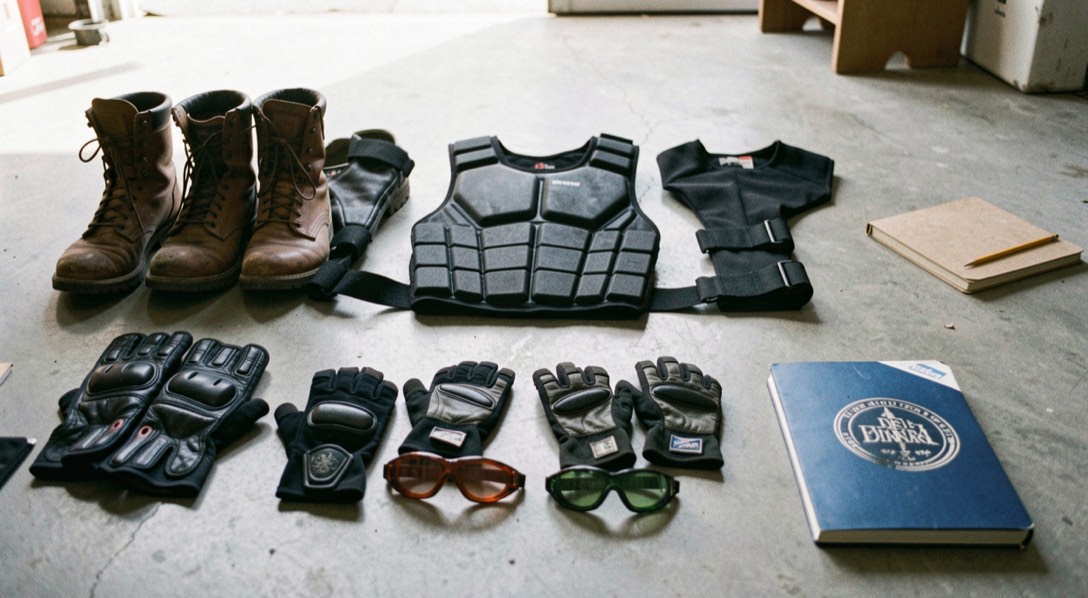
For a day on a private track, the shortest defensible answer is to wear what the AMA racing rulebook makes mandatory for its own competitors, a full face helmet with a recognized certification label, boots at least 8 inches high, a chest and back protector and shatterproof goggles, then add what it only recommends, and pack the rest by habit. That rulebook does not apply on private ground. It is still the only public document that sorts riding gear into mandatory, recommended and unmentioned, and the sorting is the useful part.
Three columns, one rulebook
The equipment section of the 2026 rulebook, section 1.2 for motocross, is short. The table keeps its three categories and paraphrases each rule; where wording matters, the rulebook's own text governs. One oddity: the chest protector appears in the mandatory rule and again in the recommended list. The mandatory rule binds.
| Item | Status in the AMA rulebook | What the rule actually says |
|---|---|---|
| Full face helmet | Mandatory | Required in practice and competition. Intact, unmodified, chinstrap retention, proper fit, properly fastened. No cameras or accessories attached. |
| Certification label | Mandatory | Snell M2020 or M2025 (R and D variants included), DOT FMVSS 218, ECE 22-05 or 22-06 'P', JIS T 8133:2015, FIM FRHPhe-01 or 02. |
| Boots | Mandatory | At least 8 inches high, laces, buckles or zippers, or specially designed for leg and foot protection. |
| Chest and back protector | Mandatory | Under or over the jersey; should cover sternum, anterior and posterior ribs, and spine from T1 to T12. |
| Goggles or face shield | Mandatory | Shatterproof. |
| Gloves, neck brace, knee braces | Recommended | Available protective equipment riders are recommended to use. |
| Helmet removal device; name, allergies, blood type on the helmet base | Recommended | Recommended, not required. |
| Jersey and pants, elbow guards, kidney belt, ear plugs, water, tools | Not addressed | No rule either way; the jersey is named only as the layer the protector goes under or over. |
What does a DOT label actually certify?
The DOT label is the familiar one in the United States, and the most often misread. It refers to Federal Motor Vehicle Safety Standard No. 218, whose scope describes minimum performance requirements for helmets designed for motorcyclists. The impact attenuation test, S5.1, sets three limits: peak acceleration not above 400 g, no more than 2.0 milliseconds cumulative above 200 g, and no more than 4.0 milliseconds cumulative above 150 g. Under S5.6.2 the label must carry the symbol DOT and the precise model designation in characters at least 0.09 inch high.
What the label does not say is as useful. FMVSS 218 compliance is a manufacturer self-certification: the maker declares that the model meets the test, and no federal office tests each helmet before sale. A DOT label is a statement about a bench test on that model, not a promise about any crash on any track. It satisfies the rulebook's list, and says nothing about how a used helmet has been treated since.
Does any of this apply on private ground?
No. A practice loop behind a house or a shop is not a sanctioned meet, and the AMA rulebook binds nobody there: no referee, no gear check, no penalty for a 6 inch boot. That is why the list is worth having. On a sanctioned day someone else enforces it; on a private day the enforcement is whatever the rider and the owner agreed on before the first bike started. The same is true of flags, and the case for borrowing a reduced set is made in course markers and flags. Treating the mandatory column as the floor and the recommended column as the default costs nothing and removes the argument.
What goes in the truck
The list is ordered the way the day is loaded: worn, carried, and what is neither gear nor tool but stops the day if missing. Check it in the garage, where a missing item is a walk to the shelf, not a drive home.
- Worn: helmet. Full face, label present, shell intact, strap fastened, nothing attached to it.
- Worn: goggles. Shatterproof, with a second pair packed for a wet day.
- Worn: boots. At least 8 inches high, every buckle closing.
- Worn: chest and back protector. Covering sternum, ribs and spine, under or over the jersey.
- Worn: gloves, neck brace, knee braces. The rulebook's recommended set.
- Carried: the tools this bike needs. Whatever loosens on it, plus a tire gauge and a pump.
- Carried: spares that end a day. A lever, a clean lens, a chain link, fuel and premix if the bike takes it.
- Papers: the helmet note and a phone. Name, drug allergies and blood type at the helmet base, as the rulebook recommends, and a phone with signal at that property.
- Water. More than the day appears to need, some of it for goggles and hands.
Fit is checked at home, not at the gate
The rulebook's helmet rules are condition rules as much as label rules: intact, unmodified, proper fit, properly fastened. None can be read off a label, and none are easy to check with the truck running late. A helmet that moves on the head with the strap fastened does not meet the fit rule, whatever the sticker says. A protector that stops short of the lower spine does not reach T12. The place to find that out is the garage floor, which is why this is a garage list. The first day out is when the list is longest and the habits are not yet formed; how that day is paced is set out in a first practice day.
A rider who comes to the sport as an adult loads the same truck, and what changes for the first weekend as an adult is mostly what gets left at home.
The label is the floor
A certification label says a sample of that model passed a bench test. Fit, condition and the strap are checked by the rider, every time. On private ground nobody else is going to.
Sources checked for this note
The equipment rules, boot height, T1 to T12 coverage, helmet conditions and the recognized certification standards are quoted from the American Motorcyclist Association, AMA Racing Rulebook 2026, revision of March 17, 2026, motocross section 1.2 on rider equipment, checked September 5, 2026. The scope, the S5.1 impact attenuation limits and the S5.6.2 labeling requirement are quoted from the National Highway Traffic Safety Administration, 49 CFR 571.218, Motorcycle helmets, current text, checked September 5, 2026. FMVSS 218 compliance is a manufacturer self-certification against a performance test, not a promise about any impact. A private track is bound by neither document; the checklist order is this desk's own and carries no authority.