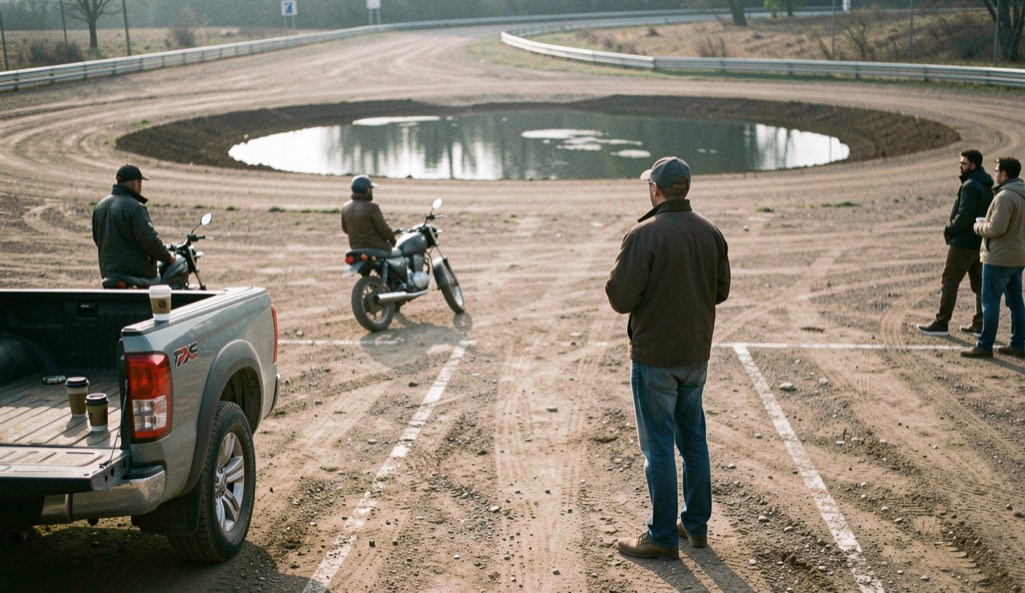
You can be wrong about a track for a whole session because of a decision you made in the parking lot without noticing you had made it. Tire choice, pressure, how much you soften the clickers, whether you go out in the first group or wait: all of that gets decided before the engine is warm, and all of it depends on a reading of the surface made from fifty yards away. The reading is worth doing on purpose.
Start with the dust, not the dirt
The first thing to look at is the air, not the ground. If a bike or a truck has moved on the property in the last few minutes, watch what it left behind. A plume that hangs at head height and drifts sideways means a dry, fine surface with no moisture under the crust. A plume that lifts and drops back within a few feet means there is water somewhere in the top inch. No plume at all, from a vehicle moving at a decent speed, means the surface is genuinely damp and the day will start with a lot of grip and a lot of roost.
The reason dust behaves that way is that the fine fraction of the surface is what becomes airborne, and moisture makes those fine particles stick to each other instead of lifting. The federal emission factor document that quantifies dust from unpaved roads defines that fine fraction as silt, meaning particles smaller than 75 micrometers, and treats surface moisture as the variable that keeps it on the ground. That document is about roads rather than tracks, but the physics is the same soil.
Color lies less than it seems, but only in the shade
A wet surface is darker than a dry one, which everybody knows and almost everybody misuses. The problem is sun. A surface in direct light at ten in the morning can read as several shades lighter than the identical surface twenty feet away in the shadow of a tree line. If you want to judge moisture by color, judge it in one lighting condition and compare like with like: shade against shade, or a stretch under cloud against another stretch under cloud.
The comparison that does work in full sun is between the middle of the lane and the untouched edge of the track. Loose material pushed to the edge is usually drier than the packed line, because it has more surface area exposed. If the edge and the line look the same, the whole surface has dried to the same depth, and the track will not develop a groove today. It will just get looser.
What does standing water tell you?
Water lying on the surface is easy to see and easy to over interpret. What matters is not the puddle. It is the shape of the ground around it.
- A puddle with a hard, clean edge and dry ground within a foot of it is sitting in a spot with no drainage at all. It will still be there this afternoon and it will still be there next week.
- A puddle with a wide, darker halo around it is draining, slowly. That halo is the part that will be greasy in an hour, when the free water is gone and the surface underneath is still saturated.
- A dark ring with no water in the middle is yesterday's puddle. That is the softest ground on the property and the place a rut will get deep first.
The third case is the one riders miss, because there is nothing shiny to look at. Where water sits repeatedly is a drainage problem rather than a weather problem, and it gets fixed with a shovel and a grade, which is the subject of drainage after rain.
Read the tires that got there before you
The parking area itself is a test strip. Look at the tracks the last few vehicles left on the way in.
| Surface | What to expect on the track | |
|---|---|---|
| Crisp, with sharp knob edges | Damp, holding shape | Grip early, a groove forming by mid morning, roost from the start |
| Soft edged, material pushed sideways | Dry and loose on top, damp below | Loose first laps, then better as riders cut through the crust |
| Barely visible, dust drifting off it | Dry through | No groove, blue groove polish on the hard parts, heavy dust |
| Deep, with water in the bottom | Saturated | Ruts that keep deepening, mud packing under fenders |
How does the reading change with the hour you ride?
A reading made at seven in the morning describes a surface that will not exist at one in the afternoon. That is not a flaw in the reading, it is the thing the reading is for. Once you know where the moisture is, you know which direction the track will move.
The same federal document notes that unpaved surfaces have a hard, generally nonporous top layer that dries quickly after rain or watering, partly because traffic itself speeds up the evaporation. On a track that means the surface you looked at will get drier faster the busier the day is, and that a track running four full groups will need attention sooner than the same track running two.
The parking lot rule
Read the air first, the edges second, the low points third, and never judge moisture by color across two different lighting conditions.
Then go and check it on foot
None of this replaces walking. The parking lot reading gives you a hypothesis and a tire choice; the walk tells you whether the hypothesis survives contact with the corners, and where the exceptions are. The route for that walk is in how to read a track, and the thing you will most want to know afterward, which is when the property was last watered and how heavily, is explained in watering a track.
Sources checked for this note
The definition of silt as particles smaller than 75 micrometers, the role of surface moisture in keeping them out of the air, and the observation that unpaved surfaces dry quickly through traffic enhanced evaporation all come from the United States Environmental Protection Agency, AP-42 Compilation of Air Emissions Factors, Section 13.2.2, Unpaved Roads, checked September 5, 2026. That document covers unpaved roads, not motocross tracks, and is used here only for the behavior of the soil. The tire print table and the reading order are this desk's working method, not measurements.