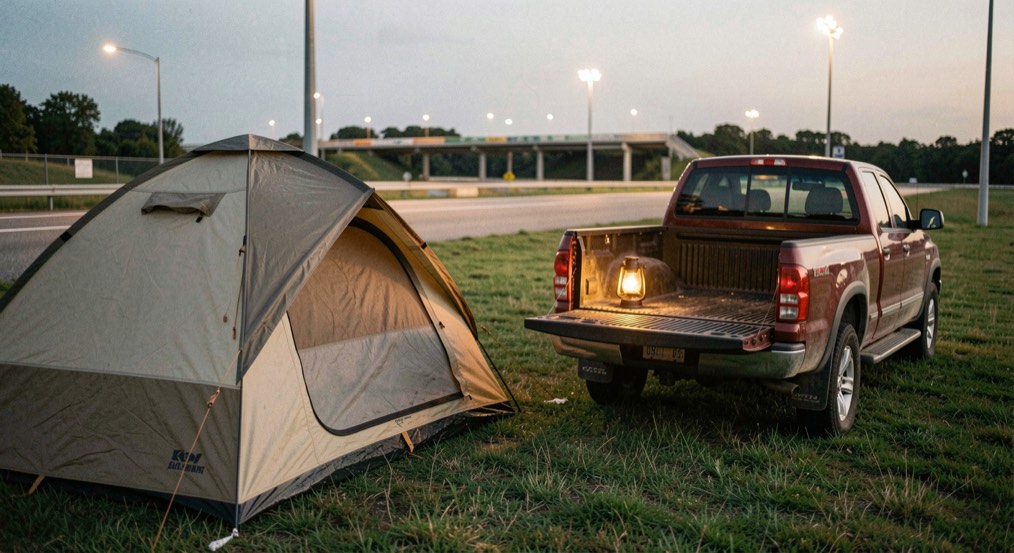
For two nights beside a private track, the base that works sits on ground slightly higher than what surrounds it, upwind of the track under the wind that blows at dawn, off every lane a tractor or a water truck uses, and clear of any low strip of grass running across the field. Those four checks take a quarter of an hour on foot the evening you arrive. They decide whether the tent is dry, whether the first moto at six in the morning covers the camp in dust, and whether the owner wants the truck back.
Reading the field before pitching
The order matters: each check rules out ground the next one might have accepted, and shade comes last because a tarp can supply it.
- Slope and water. Stand at the low point of the field and look uphill; rain falling above the track passes through somewhere on its way down. Skip every hollow, every channel, every ridge with a channel along its uphill side, and every strip of short grass crossing the slope.
- Wind and dust. Note the wind at dusk and again at first light; dust travels with it, and the two readings often differ.
- Machine traffic. Find the gate, the fuel and water points, the tractor's route and where the water truck loads and turns; nothing of yours sits on those lines.
- Morning shade. It falls on the west side of a barn or a tree; that is the side the tent goes on.
Where does the dust actually go at six in the morning?
Downwind, and farther than the eye expects, because the part that carries is the finest fraction. The Environmental Protection Agency's document on unpaved roads defines silt as particles smaller than 75 micrometers in diameter, the fraction that lifts under a wheel and stays up. The document is about unpaved roads, not motocross tracks; what it says about a dry surface under traffic is this: it usually dries quickly after watering because of traffic enhanced evaporation, the reapplication interval for plain water in summer can be a matter of minutes, and control depends on the water put down, the interval, the traffic in between, and the weather.
For a camper that says two things: upwind of the track under the dawn wind, not the evening breeze, and away from the point where the water truck loads and turns, where the truck passes most often, the ground goes wet and then dry again, and fine material is most available to the next wheel. How the watering itself is planned is in watering a track.
What does a wide strip of short grass across the field mean?
Usually that it is a channel, and that water has been sent there on purpose. The Natural Resources Conservation Service describes a grassed waterway as a shaped or graded channel with suitable vegetation, conveying surface water at a nonerosive velocity through a broad and shallow cross section to a stable outlet, sized for a ten year, twenty four hour storm. It looks like a lawn. It is a drain. A diversion is the companion structure: a channel across the slope with a supporting ridge on the lower side, nonfarmable side slopes no steeper than 2:1, and always an outlet. A tent belongs neither in the channel nor on the ridge shaped to hold water against it. Both are laid out for an owner in drainage after rain.
The local storm depth such a channel is built for is readable from NOAA's precipitation frequency data server, and the drainage class of the soil under the camp from the USDA Web Soil Survey. Neither lookup replaces the walk.
Five spots, judged
Each of these looks like the obvious place at dusk. The judgments are this desk's method, not a rule of any property.
| Spot | Why it looks good | Why it fails |
|---|---|---|
| The low flat grass by the corner | Level, soft, close to the action | Water settles there, the first storm proves it, and every roost off the corner lands on it |
| The ridge line | Dry, a view of the whole loop | With a channel along its uphill side it is a diversion ridge, built to hold water; also the most wind exposed ground |
| Under the only tree | Shade, a place to hang gear | Everyone wants it, machines park under it, and it drips for an hour after rain |
| Beside the water tank | Water for washing, an easy landmark | The truck loads there all day, the ground goes slurry then dust, and the engine runs at first light |
| The upwind fence line | Out of the way, dust blows away from it | Rarely fails; check that the gate lane does not run along it |
Staying out of the way of the track and the water truck
None of this is a regulation; the owner sets the rules. Ask the owner three things before the tent comes out: where the machines run, where a fire is acceptable if at all, and where the nearest sanitation is. A generator runs where its noise and exhaust reach nobody's tent, never overnight without agreement; a fire only where the owner says, on bare ground, out before the last person sleeps. Nothing, not a chair, not a fuel can, stands within reach of a bike leaving the track. The pickup parks nose out. The camp closes the way it opened, nothing left the owner has to explain. The riding load is in a gear checklist, the read of the surface before the first moto in reading track conditions.
For a guy line that keeps slipping after it loads, tie a bowline at the stake end instead of a simple loop. Pull about 12 inches of tail, form a small loop in the standing part, bring the tail up through it, around behind the standing part, then back down through the loop. Cinch it hard and set it by hand before you tension the line. The knot holds under load and still breaks free with a quick push and pull once you strike camp. If the collar loosens on slick cord, check the dressing notes in this bowline for a guy line reference, then retie with a longer tail.
The dawn wind decides
Choose the spot by the wind at first light, not by the wind at dusk. The dust arrives with the first bike of the day, and that makes it a morning problem.
Sources checked for this note
Silt, drying under traffic, the reapplication interval and the control variables are from the United States Environmental Protection Agency, AP-42, Section 13.2.2, Unpaved Roads, checked September 5, 2026; it addresses unpaved roads, not motocross tracks. The diversion, the grassed waterway, the 2:1 slope, the ten year storm and the outlet are from the USDA Natural Resources Conservation Service, Conservation Practice Standard 362, Diversion, print date March 2022, and Conservation Practice Standard 412, Grassed Waterway, print date September 2020, both checked September 5, 2026. Storm depth is read from the NOAA Precipitation Frequency Data Server and drainage class from the USDA Web Soil Survey, checked the same day. The checks, the table and the camp rules are this desk's method and set no legal distance or noise limit.