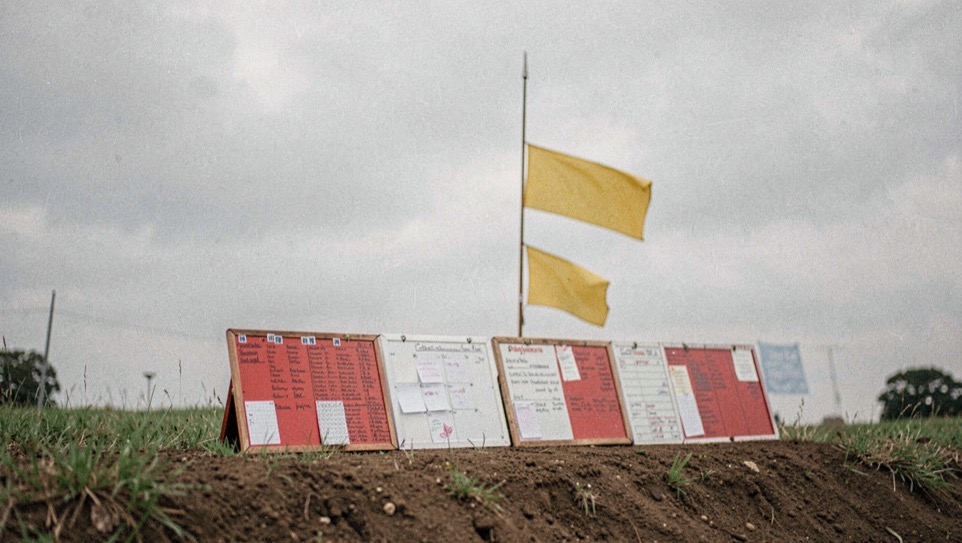
Everything else on a track has to be interpreted. The surface has to be read, a rut has to be judged, a jump face has to be guessed at from the approach. Flags and markers are the exception: they are the only part of a track that means exactly one thing, and the meaning is written down in a public document. This note sets out what that document says and what a private practice track can take from it.
Markers say where, flags say what
A marker board, a stake or a line of tape defines the edge of the course. It is a statement about geography and nothing else: inside is track, outside is not. Riders treat markers as advisory and they are usually wrong to, because a marker is very often standing exactly where it is to keep traffic off ground that will not hold.
A flag is different in kind. It is an instruction addressed to you, issued after the fact you were planning around has changed. It overrides the line you chose, the jump you were going to take and the pass you were setting up. On a sanctioned event it also carries a penalty, which is the clearest possible signal that it is not advisory.
A marker says where the course runs, and how long that course is, whether its corners carry names at all, is a separate measurement, taken in how long a lap really is.
The published list
The current American Motorcyclist Association racing rulebook specifies flags measuring 30 inches by 30 inches, and gives each one a single meaning. The table below is a summary of that section; the wording that governs is the rulebook's own.
| Flag | Meaning | What it requires |
|---|---|---|
| Green | Start of race | Nothing beyond going |
| Yellow | Caution | Ride cautiously until past the incident, no passing, no gaining an advantage, and jumps must be rolled between the flag and the incident. Penalty is loss of five positions or disqualification. |
| White with red cross | Ambulances, safety vehicles or emergency personnel may be on the course | Extreme caution until past the incident, no passing, jumps rolled. Penalty is loss of ten positions or disqualification. |
| Red | Stopping of a race for an emergency | Return cautiously to the starting line and wait for instructions |
| Blue | You are about to be overtaken by faster riders | Hold your line and do not impede their progress |
| Black with a one inch white border | Disqualification of a rider | Report to the referee at once |
| White | One lap to go until the finish | Courtesy only |
| Black and white checkered | End of the race | Nothing, though a flag shown to the wrong rider reverts the finish to the leader's last complete lap |
The three that change what you do inside one second
Yellow, red cross and red are the flags that require an immediate change of behavior, and two of them contain the same specific instruction that riders most often miss: jumps must be rolled between the flag and the incident. Not jumped smaller. Rolled. That instruction exists because the reason for the flag is very often a person on the ground on the far side of a face you cannot see over.
The rulebook also states that a red light has the same meaning as a red cross flag and a yellow light the same meaning as a yellow flag, which matters on properties that use lights on the far side of the loop where a flagger cannot stand safely.
What can a private track borrow from the rulebook?
A private practice track is not obliged to run any of this. Many owners run a reduced version anyway, because the alternative is that riders on the property have no agreed way to say stop. Three things are worth copying and cost nothing.
- One yellow and one red, and everybody knows them. Two flags, one meaning each, explained out loud before the first session, are worth more than eight flags nobody has agreed on.
- A fixed place to display them. A flag that appears in a different place each time is a flag that gets missed. A single point visible from the start straight is enough on a short loop.
- Rolling, not jumping, as the default under caution. It is the instruction that protects the person on the ground, and it is the one worth stating explicitly rather than assuming.
The point of a marker
A marker board is usually standing where it is because the ground beyond it will not hold. Treat it as information about the surface, not as decoration.
What does a moved marker tell you?
Because markers get moved when a track is reshaped, a leaning or freshly set stake is a dated record of recent work. A line of new stakes tightening a corner means the previous line was cut too wide, which usually means the outside edge was breaking up. That is a piece of information about the surface you would otherwise have to discover at speed, and it is one more thing worth noting on the walk described in how to read a track. What a flagged session feels like from the inside is covered in a first practice day.
Sources checked for this note
The flag dimensions, the eight meanings, the penalties for passing or jumping under caution, and the equivalence of red and yellow lights are quoted from the American Motorcyclist Association, AMA Racing Rulebook 2026, revision of March 17, 2026, motocross section on flags, checked September 5, 2026. A private track is not bound by that rulebook; the suggestions for borrowing from it are this desk's own and carry no authority.