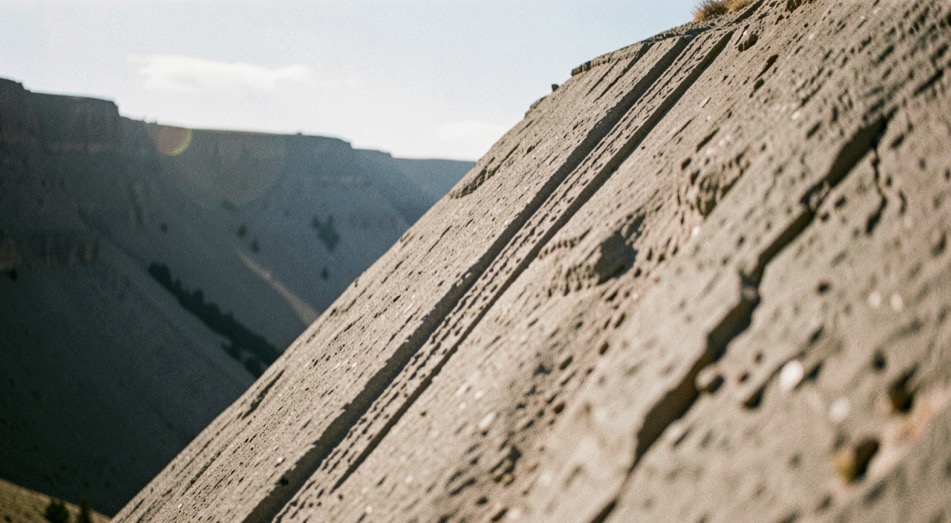
A jump face is the only part of a track that has to be read at speed and cannot be renegotiated once you are committed to it. What happens in the air was settled in the last twenty feet of dirt before the lip: throttle, gear, where the front wheel was pointing, and whether the ramp let the suspension do its job. This note takes a face apart from the approach up, writes out the arithmetic of what a takeoff angle buys, and says where that arithmetic stops being useful.
The face starts well before the lip
Riders talk about a face as if it began where the ground turns upward. It begins at the last place the surface is flat enough to hold a steady throttle, which on most private tracks is somewhere between fifteen and thirty feet earlier. That flat is where the gear choice becomes irreversible. If the run in is chopped, the bike arrives at the ramp already moving on its suspension and the takeoff inherits that movement.
Walk the run in and the ramp together, in the direction of travel, the way this desk sets out in how to read a track before you ride it. Three things decide whether a face is honest: whether the ramp is continuous or has a step in it; whether the top is cupped, meaning hollowed out with a raised lip on the near edge; and whether loose material sits where the flat meets the climb, because that is where a front wheel loses its steering just as the load comes on.
What does the range formula say?
The distance a projectile covers between two points at the same height is a piece of school physics, and it is worth writing out rather than repeating as folklore. With a takeoff speed of v, a takeoff angle of theta above horizontal, and gravity g, the range is v squared multiplied by the sine of twice theta, divided by g. In United States units, g is 32.2 feet per second squared, and one mile per hour is 1.4667 feet per second.
The table below is this desk running that formula, nothing more. It assumes takeoff and landing at the same height, no air resistance, no suspension extension at the lip, and no rider input in the air. Every one of those assumptions is wrong on a real track, which is the point of the section after it.
| Takeoff speed | Face at 15 degrees | Face at 20 degrees | Face at 25 degrees |
|---|---|---|---|
| 20 mph | 13 ft | 17 ft | 20 ft |
| 25 mph | 21 ft | 27 ft | 32 ft |
| 30 mph | 30 ft | 39 ft | 46 ft |
| 35 mph | 41 ft | 53 ft | 63 ft |
Reading the table
Two things fall out of it.
Speed appears squared, so it dominates. Going from 25 to 30 miles per hour is a twenty percent change in speed and roughly a forty four percent change in distance. That is why a rider a gear high through the run in overshoots a landing that looked generous on foot, and why the correction is almost always made with the throttle, not the body.
Angle matters, but less than riders expect, and it stops paying. Between 15 and 25 degrees at the same speed the table adds about half again to the distance. Push the angle much further and the range starts falling back toward the middle, because the sine of twice theta peaks at 45 degrees and declines after it. A face steeper than that stops being a jump and becomes a launch: it converts forward speed into height and leaves the bike nose high with nothing under the rear wheel.
The same numbers give the time in the air and the peak height. At 30 miles per hour off a 20 degree face, the formula gives about nine tenths of a second of flight and a little over three and a half feet above the lip. Nine tenths of a second is long enough for one correction with throttle and brake, and short enough that there is exactly one.
What can the arithmetic not tell you?
Four things, all of them bigger than the rounding in that table.
- The suspension. A bike compresses on the ramp and extends at the lip. That extension adds vertical velocity the formula knows nothing about, and it is why the same face at the same speed sends a soft bike further and higher than a stiff one.
- The landing height. Almost no landing sits level with its lip. A downslope landing lengthens the flight, and the table becomes a floor rather than a prediction.
- The surface. A ramp that gives up material under the rear wheel bleeds speed in the last few feet, exactly where the formula assumes it is constant.
- The rider. Throttle, brake and body position in the air change attitude, and attitude changes where the bike touches down even when the arc does not change much.
So the table is a way of thinking about proportion, not of predicting a landing. It answers whether a face cut back a foot still works at the same gear, and whether a rider is complaining about a jump or about a run in.
The one thing to take away
Speed is squared and angle is not, so on a face you already know, the gear is the decision and the lip is only the consequence.
A face is a maintained object
Faces do not hold their shape. Every pass loads the same band of the ramp, and material moves from that band to the top of the lip and over it. Left alone, a face steepens near the crest and hollows below it, which is the cupping that turns a predictable takeoff into a kick. The repair is not complicated, but it has to be done before the hollow gets deep enough to hold water, and the sequence for that is in grooming a track.
The same wear mechanism, running along a straight instead of up a ramp, produces the regular ridges covered in whoops and braking bumps on a beaten straight. A face and a whoop are the same process at different scales, and reading one teaches you to read the other.
Sources checked for this note
The range relation, the flight time and the peak height are standard projectile motion, computed by this desk with gravity at 32.2 feet per second squared and rounded to whole feet. They are arithmetic, not measurements: no jump on any property was surveyed for this page, and the stated assumptions of level landing, no drag, no suspension extension and no rider input are all violated in practice. Treat the table as a way of comparing cases, and never as a number to aim at.