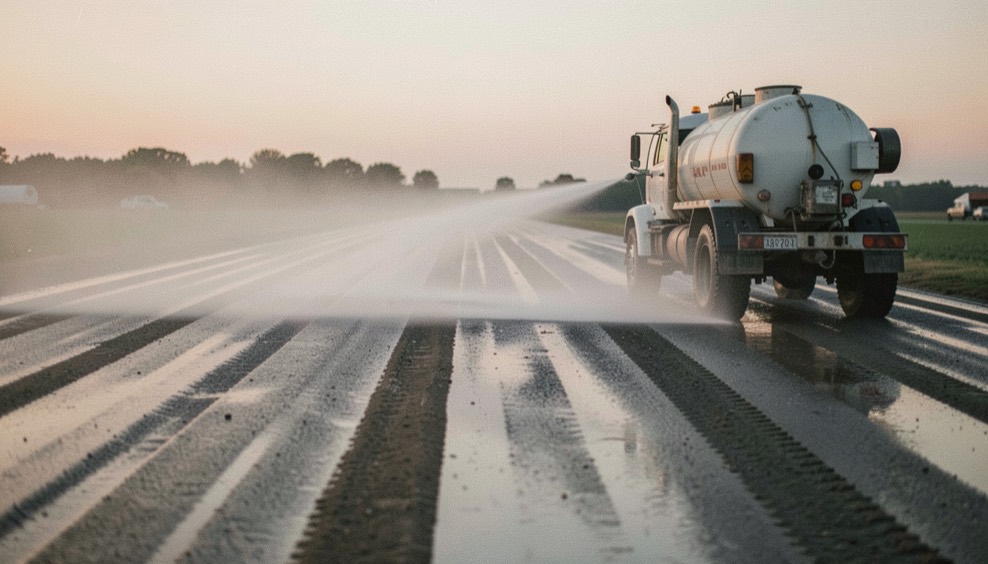
Ask ten people how to water a track and you will get ten volumes. Nobody says a time or a frequency, and almost nobody says how deep the water should go. Yet the one public document that has quantified this says the volume is the least interesting variable. This note works through what it says, converts it into gallons, and ends with a schedule rather than a number.
What the federal dust document actually found
The Environmental Protection Agency maintains a compilation of air emission factors, and its section on unpaved roads deals directly with watering as a dust control. It defines the dust producing fraction of a surface as silt, particles smaller than 75 micrometers, and states that watering works by raising the moisture content so those particles stick together instead of lifting when a wheel passes.
The important part is the shape of the relationship. The document presents a bilinear curve between control efficiency and the increase in surface moisture, described in one sentence worth reading twice: between the uncontrolled moisture content and a value twice as large, a small increase in moisture content results in a large increase in control efficiency, and beyond that, control efficiency grows slowly with increased moisture content.
In plain terms: getting the surface from bone dry to twice as damp is nearly all of the benefit. Getting it from twice as damp to four times as damp costs the same water again and buys a fraction as much. The document is about roads, not tracks, but it is the same soil and the same wheels.
How much water doubles the moisture, in gallons?
The desk works this out for a track surface twelve feet wide and twelve hundred feet long: 14,400 square feet, about a third of an acre. The assumptions are stated so you can change them: a soil bulk density of 1.4 grams per cubic centimeter, and a target depth of two inches, which is the layer a tire actually works.
Two inches of that soil weighs about 6,600 grams per square foot, or roughly 14.6 pounds. Raising its moisture content by one percentage point by weight therefore takes about 66 grams of water per square foot. Over the whole surface that is about 251 gallons, and it corresponds to a water depth of only about 0.028 inch.
| Increase in moisture, by weight | Water per square foot | Over the whole surface | Equivalent depth |
|---|---|---|---|
| One point | 66 g | about 251 gallons | 0.028 in |
| Two points | 132 g | about 503 gallons | 0.056 in |
| Three points | 198 g | about 754 gallons | 0.084 in |
For comparison, an application of one tenth of an inch over the same surface is about 898 gallons, and a quarter of an inch is about 2,244 gallons. A single quarter inch pass is therefore already far past the point where the curve flattens, and most of that water either runs off the crust or sits on top waiting to evaporate.
Why a big single pass performs worse than it looks
Two things happen when a large volume goes down at once on a dry surface. A dry crust sheds water rather than absorbing it, so a large share runs to the low points, which is how a track ends up with a wet corner and a dusty straight after one pass. And the water that does soak in raises the moisture well past the flat part of the curve, where it buys almost nothing, and that excess is exactly what has to evaporate before anyone can ride.
The same document lists what controls how long a watered surface stays useful: the amount applied per unit of area, the time between applications, the weight, speed and number of vehicles passing during that interval, and the weather affecting evaporation. Three of those four are about the schedule, not the volume.
A schedule instead of a number
- Wet before it is dry, not after. The curve rewards keeping the surface above the dry threshold, which is far cheaper than bringing a fully dried surface back.
- Split the load. Two passes of a light application, separated by enough time for the first to soak, put more water into the soil and less into the low points than one heavy pass.
- Water against the traffic, not against the clock. The document is explicit that traffic during the interval is one of the four variables. A busy session shortens the interval; an empty afternoon lengthens it.
- Time the last pass so evaporation, not the schedule, decides. The same document notes that plain water on an unpaved surface in summer can need reapplication in a matter of minutes at the extreme, which is a warning about hot afternoons rather than a rule.
The rule this note is for
Doubling the moisture buys nearly all the dust control. Everything past that costs full price for very little return, so spend the effort on frequency and timing.
How do you tell whether a pass worked?
Do not judge by the color of the surface, which is a lighting artifact as much as a moisture one, as discussed in reading track conditions. Judge by depth. Push a thin rod into the surface in three places twenty minutes after the pass and see how far down the damp goes. Within half an inch, the water is sitting on the crust and will be gone shortly. At an inch and a half to two inches, the pass has done its job.
The federal document makes the same point in its own way: surface samples are to be collected while traffic is running. A measurement taken on an idle track describes an idle track.
Where the water goes afterward
Water that neither soaks in nor evaporates has to leave, and where it leaves from is a design question, not a watering question. If the same low point holds water after every pass, no schedule fixes it; that is the subject of drainage after rain. And a pass of water immediately before an implement behaves very differently from the same pass afterward, which is taken up in grooming a track.
Sources checked for this note
The definition of silt, the bilinear control efficiency relationship of Figure 13.2.2-2, the four variables that govern control efficiency, the range of reapplication frequency and the instruction to sample during active traffic are all from the United States Environmental Protection Agency, AP-42 Compilation of Air Emissions Factors, Section 13.2.2, Unpaved Roads, checked September 5, 2026. That document addresses unpaved roads and not motocross tracks. The gallon figures are this desk's arithmetic from the assumptions stated above, using 27,154 gallons per acre inch; they are a calculation and not a measurement of any property.