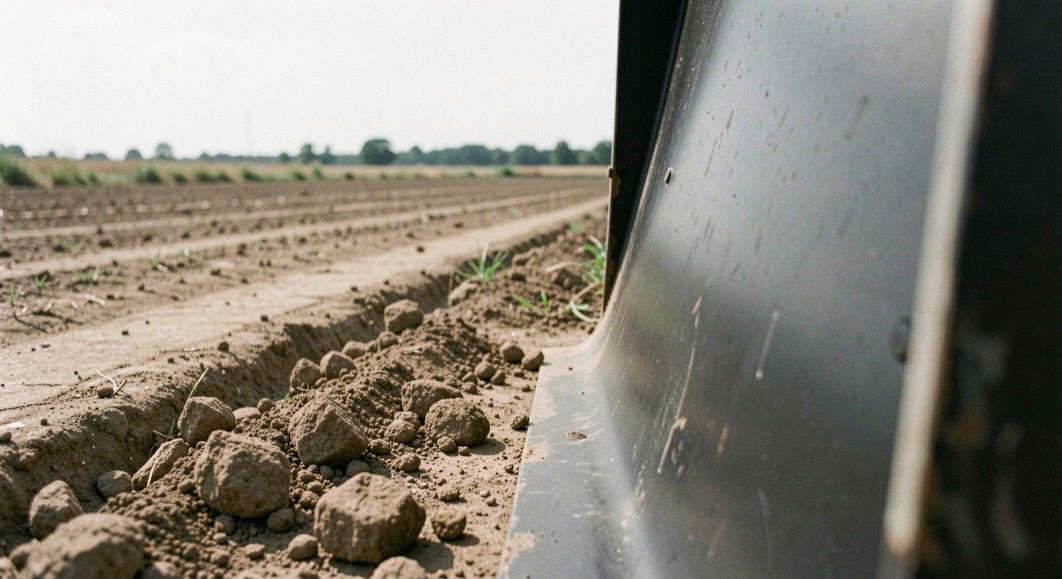
A berm is the cheapest speed on a private track and the first thing to fail. It is a wall of loose material asked to supply the side force that a flat corner has to get from tire grip alone. Riders describe berms in terms of feel, which is fair, but the reason a berm works or does not is a relation with two variables in it, and once that relation is written down a great deal of berm folklore turns out to be arithmetic.
What is a banked corner actually doing?
On a flat corner, everything that turns the bike comes from the tire and the lean angle. Bank the surface and part of the turning force comes from the ground pushing sideways on the tires, which is force the tire no longer has to find in grip. The banking angle at which the ground does the whole job on its own, with no help from grip at all, is given by a short relation: the tangent of the angle equals the speed squared, divided by gravity multiplied by the radius of the corner.
That is the neutral angle. Below it, the rider makes up the difference through the tire. Above it, the bike is being pressed into the face and the rider can go faster still. The table below is this desk applying that relation with gravity at 32.2 feet per second squared, rounding to a tenth of a degree.
| Corner radius | At 15 mph | At 20 mph | At 25 mph |
|---|---|---|---|
| 20 ft | 36.9 degrees | 53.2 degrees | 64.4 degrees |
| 30 ft | 26.6 degrees | 41.7 degrees | 54.3 degrees |
| 40 ft | 20.6 degrees | 33.7 degrees | 46.2 degrees |
The number that makes the point
Set that table next to a published earthwork standard and the problem becomes visible. The Natural Resources Conservation Service standard for a Diversion, which is a constructed channel with a supporting ridge of soil on the low side, states that for nonfarmable slopes the steepest side slope allowable is 2 horizontal to 1 vertical, unless an analysis of site specific soil conditions indicates that steeper slopes will be stable.
Two horizontal to one vertical is about 26.6 degrees. That is a federal agency, writing about deliberately constructed ridges of earth, capping the face at roughly the angle our table needs for a 30 foot corner at 15 miles per hour. Every faster or tighter case in the table asks the dirt to stand steeper than the standard will allow without soil analysis. That is not a rule that binds anybody building a practice track, and the standard was written for water control rather than for motorcycles. It is a very good indication of what unanalysed soil will actually hold.
Who pays the difference?
The gap between the angle the corner wants and the angle the dirt will keep has to be paid by somebody, and there are only three payers.
- The tire pays, through grip and lean, and the price is that the edge of the tire is now cutting into the face rather than riding on it.
- The soil pays, through moisture and compaction, which is the only way a face stands steeper than it would when loose and dry.
- The rider pays, by going slower, which is what actually happens on a berm nobody trusts.
The first payer is why a berm that is too flat for the speeds being carried gets cut into ruts from the inside out. Riders supply the missing side force through the tire edge, the tire edge digs, the digging removes material from the very part of the face that was providing support, and by the end of a hot afternoon the berm has been converted into the rut corner covered in rut corners, picking a line and holding it.
The one thing to take away
A berm that keeps getting cut apart is usually not badly ridden, it is too flat for the speed the corner is carrying.
Riding a berm that is honest
On a berm at or above its neutral angle, the useful instruction is to look further round the corner than feels natural and to be off the brakes before the face starts to turn the bike. Braking on a berm face loads the front tire into a surface that is trying to push the bike outward and upward at the same time, and it is the most reliable way to slide down the face. Where the entry line comes from, and why the exit is worth more than the entry, is set out in riding lines, where the clock is actually won.
Two conditions ruin an honest berm. A dry face with loose material on it cannot hold the compaction it was built with, and the first tires through take it apart. A saturated face slumps under load and leaves a smooth greasy band at the height everybody is riding. Between those two there is a moisture window, and keeping the face inside it is a maintenance job rather than a riding one, described in watering a track.
Building the wall in the first place
Nothing above helps if the wall was never built to hold. A berm is a mass of material with a face on it, and the face is the smallest part of the problem: what keeps it standing is the volume behind it and how that volume was compacted. Material, layer thickness, moisture and compaction are taken up separately in building a berm, which is the note to read before moving any dirt.
Sources checked for this note
The side slope figure comes from the United States Department of Agriculture, Natural Resources Conservation Service, Conservation Practice Standard 362, Diversion, print date March 2022, read at the NRCS national handbook copy on September 5, 2026. That standard governs water control structures and does not regulate motocross tracks. The banking angles are this desk running the standard banking relation, rounded to a tenth of a degree, ignoring tire deformation, suspension geometry and any variation of radius through the corner. No berm on any property was surveyed for this page.