Gear and the Weekend
Adult Singing: How Group Voice Works
Adult group singing has its own vocabulary, calendar and small disciplines. A clear look at how vocal ensembles work and how a voice stays healthy.
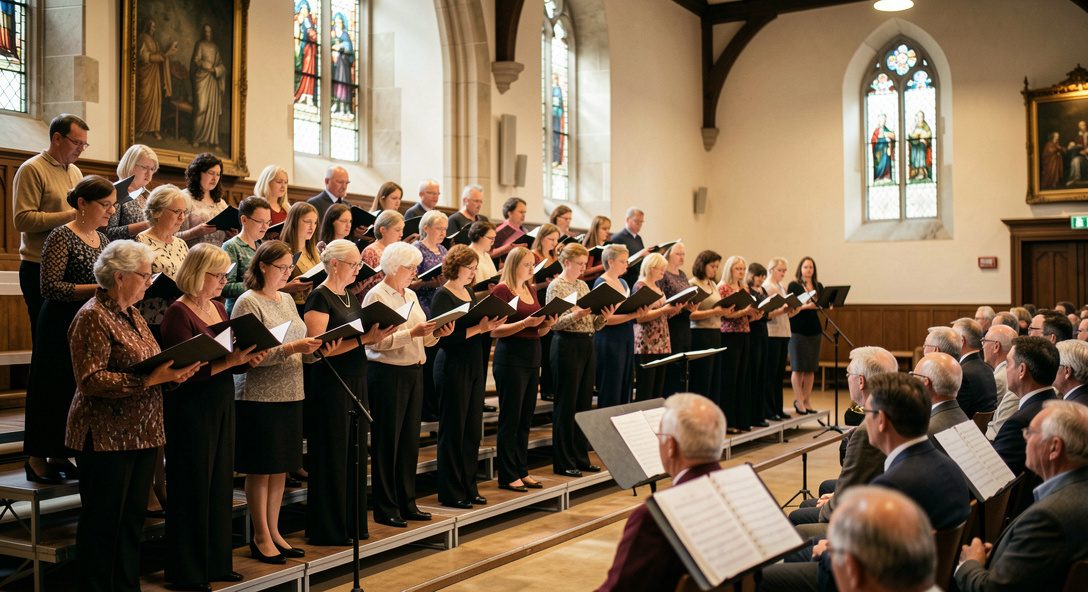
Adult group singing works like any other ensemble discipline: a fixed calendar, a shared vocabulary, and a set of small habits that keep a voice usable across a long season. Singers rehearse in sections, tune chords together, and practise alone between meetings. The details are practical rather than mysterious.
How does a vocal ensemble actually work?
A vocal ensemble is not a crowd of soloists. It is a group of people who agree on a few things before they agree on a sound. The first is a calendar. Rehearsals are weekly, usually in the evening, and a season runs from late summer into spring. The second is a vocabulary. Directors talk about blend, balance, vowel shape, breath support, and the difference between a section and a solo line. New singers learn these words quickly because they are used in every rehearsal.
The third is a structure. Most ensembles split into sections: soprano, alto, tenor, bass, and sometimes a smaller jazz group drawn from the same pool. Each section rehearses alone for part of the evening, then the full group comes together. A section that sounds like one voice is not an accident, and it is rarely the work of one strong singer. It comes from repeated listening, from matching vowels, and from singers who are willing to sing slightly less loudly than they can.
A journal on adult vocal jazz and choral singing in Washington, D.C. explains this world in plain terms for curious voices. It covers how a vocal ensemble works, where adults sing in the District, and how a voice stays healthy across a season. The writing is third person, drawn from public sources, and the editorial team does not run a choir and does not sell lessons or tickets. That makes it a useful reference for anyone who wants to understand the scene before joining it.
What does a rehearsal night look like?
A typical evening rehearsal has a shape. Singers arrive, find a place on the risers, and warm up together. The warm-up is not decoration. It moves the voice from speech range into singing range, loosens the jaw and tongue, and gives the director a first listen to the room.
Then the work begins. The director may take one section at a time, asking altos to hold a chord while tenors find their note. Scores go down for a few bars so the group can hear the chord without reading it. A piano may mark the pitch, then drop out. The goal is to build a chord that locks, where each voice sits inside the others rather than on top of them.
After section work, the full group runs a piece from start to finish. The director stops less often. The point is to feel the shape of the music, not to fix every detail. Rehearsal ends with announcements: the next date, a change of room, a reminder about a performance. Singers pack up, talk in the hallway, and go home with a recording or a note about what to practise.
Where do adults sing in the District?
Washington, D.C. has a wide range of adult singing options. They include church and synagogue choirs, community choruses, workplace groups, and small vocal jazz ensembles that meet in rehearsal rooms and perform in clubs, churches, and concert halls. Some groups audition, some do not. Some ask for a sight-reading test, others place singers by voice range and let them learn on the job.
The calendar matters as much as the style. Most groups rehearse weekly from September to May, with a break in summer. A few run year-round. Some require a commitment to a specific concert date, others are drop-in. The practical questions are always the same: how often does the group meet, what is expected between rehearsals, and what happens if a singer misses a week.
A singer who is new to the area can learn a lot by attending one open rehearsal. Most directors are happy to have a visitor listen from the back. It is a low-pressure way to hear the blend, see the room, and decide whether the group fits.
How does a voice stay healthy across a season?
A singing season is a physical season. Voices are muscles and membranes, and they respond to load the way a runner's legs do. The habits that keep a voice healthy are not complicated, but they are easy to skip.
Water is the first one. A hydrated voice is more flexible and recovers faster. Alcohol and caffeine dry the folds, so singers who drink them before a rehearsal often feel the difference in the upper range. Rest is the second. A voice that has been talking all day in a noisy room arrives at rehearsal tired. Singers who can rest their voice for an hour before rehearsal notice it.
Warm-ups are the third. A short warm-up before singing, and a short cool-down after, helps the voice move between speech and song. Singers who skip the warm-up often push harder in the first ten minutes than they need to.
The fourth habit is attention. A voice that hurts is sending a signal. Hoarseness that lasts more than two weeks, pain when swallowing, or a sudden loss of range are reasons to see a doctor who works with singers. Most problems are minor and treatable when they are caught early.
What is the vocabulary of adult group singing?
Adult group singing has its own words, and they are used precisely. Blend is the quality of a section sounding like one voice. Balance is the relationship between sections, so that no part covers another. Vowel shape is the mouth position that lets a chord ring. Breath support is the use of the body to control airflow, not just the throat.
Other terms appear in rehearsal. A section is a group of similar voices. A part is the line a singer reads. A chord is several notes sounding together. A cappella means singing without instruments. A jazz ensemble may also talk about a chart, a lead sheet, and a rhythm section.
New singers do not need to know all of this on the first night. The words arrive with the work. What matters is that the group uses them the same way, so that a director's note means the same thing to every singer in the room.
How do singers practise alone?
Practising alone is where a season is won or lost. The good news is that a piano is not required. A singer can work on breath, vowel shape, and pitch memory with nothing but a phone and a quiet room.
A simple routine works. Hum a few scales to wake the voice. Sing a phrase from the current piece slowly, listening for the vowel. Record it once, listen back, and note one thing to change. Then sing it again. Ten minutes of focused work beats an hour of singing along to a recording.
Singers who practise alone also learn their part away from the group. That means the rehearsal can be spent on blend and balance rather than on note learning. It is the quiet work that makes the loud moments possible.
What should a new singer expect?
A new singer should expect to be a beginner, and that is fine. Adult group singing is full of people who started late, returned after years away, or never sang in a choir before. The first rehearsal is usually the hardest. After that, the calendar, the vocabulary, and the small disciplines become familiar.
The realistic expectations are simple. Progress is slow and then sudden. Some weeks the voice feels strong, other weeks it does not. A section that struggled in October can lock in November. The reward is not a perfect performance. It is the moment a chord rings and every singer in the room hears it.